
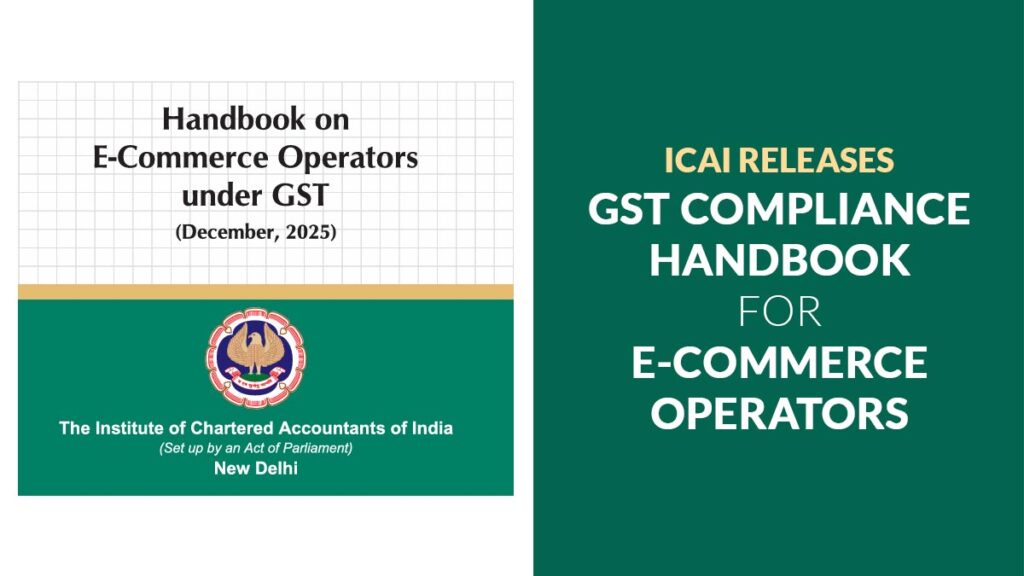
The Institute of Chartered Accountants of India (ICAI), while quoting India’s fastly expanding digital economy, released a detailed and updated “Handbook on E-Commerce Operators under GST”, proposing the much-needed clarity concerning taxation, compliance, and evolving legal provisions regulating online platforms.
ICAI’s GST & Indirect Taxes Committee issued a handbook that delivers practical guidance to Chartered Accountants, tax professionals, start-ups, e-commerce businesses, and policymakers, addressing the GST issues encountered by digital marketplaces, aggregators, and service platforms.
E-Commerce Under GST: Why This Handbook Matters
E-commerce has emerged as a major growth driver in India, though its multi-state operations, intricate supply chains, and high transaction volumes have created interpretational issues under GST. Acknowledging the same, the handbook of ICAI consolidates statutory provisions, notifications, circulars, and judicial guidance into a single reference document.
The publication is updated up to 15 December 2025, incorporating recent amendments and clarifications issued by the Government.
Areas included in the Handbook
The handbook furnishes guidance regarding all the important aspects of GST applicable to e-commerce operators (ECOs), including:
- Definition of E-Commerce and E-Commerce Operators under Sections 2(44) and 2(45) of the CGST Act
- Business Models Explained – Marketplace, Inventory, and Aggregator models
- Special GST Provisions u/s 9(5), where tax liability is transformed from suppliers to ECOs
- Tax Collection at Source (TCS) u/s 52, including rates, valuation, returns, and the matching mechanism
- GST Registration Requirements, including mandatory registration and APOB compliance
- Return Reporting in GSTR-1, GSTR-3B, GSTR-8, GSTR-9, and GSTR-9C
- Recent Notifications and Circulars, including changes w.e.f 2024 and 2025
Read Also: ICAI Extends Peer Review Requirement (Phase IV)
Section 9(5): Deemed Supplier Concept Explained
Section 9(5) of the CGST Act addresses specific services supplied through e-commerce platforms, such as passenger transportation, accommodation, restaurant services, housekeeping, and local delivery-require the E-Commerce Operator to file GST as a deemed supplier.
The handbook explains:
- When the ECO is liable to issue invoices and pay tax
- Cases where the supplier retains liability
- Cash-only payment of GST for Section 9(5) services
- Non-applicability of TCS on notified services
The same clarity is pertinent for platforms such as ride-hailing apps, food delivery services, hotel aggregators, and home-service platforms.
Compliance Insights for Sellers and Platforms
The handbook shows key compliance risks, such as:
- Mandatory declaration of ECO-managed warehouses as Additional Place of Business (APOB)
- Outcomes of wrong place of supply determination
- Impact on Input Tax Credit (ITC) and invoice validity
- Treatment of turnover for aggregate turnover calculation, even where tax is paid by the ECO
ICAI’s Commitment to GST Awareness
CA Charanjot Singh Nanda, President, ICAI, outlined that the handbook shows the devotion of ICAI to streamline the operations of business, clarity, and capacity building in India’s indirect tax ecosystem. The purpose of the publication is to be a ready reckoner for professionals navigating GST in the digital economy.
Who must read this handbook?
- Chartered Accountants & GST Practitioners
- E-commerce operators and start-ups
- Online sellers and service providers
- Finance and compliance teams
- Policy analysts and regulators
Conclusion
As GST provisions for e-commerce continue to evolve, this ICAI handbook arrives at an important time, proposing practical clarity, compliance direction, and legal certainty. This publication is an essential resource for anyone dealing with GST in the digital marketplace.
The official copy of the handbook has been attached: Click here